Integrated Environmental Management System (EMS)
Energy and Environmental Conservation Policy
The Company focuses on sustainable business operations, considering the impact on the community, society, and the environment, as well as energy conservation and efficient energy use, with the following guidelines.
- The Company is committed to implementing and developing an appropriate energy and environmental conservation management system by setting energy and environmental conservation as part of the Company's operations consistent with relevant laws and regulations.
- The Company is committed to continuously improving the efficiency of the organization's energy resource use, which is appropriate for the business, technology, and good practices.
- The energy and environmental conservation plans and goals are established on an annual basis and disseminated to all employees to understand and perform properly.
- The Company is aware of reducing environmental impacts produced by its business operations, notably in terms of energy conservation. It is the responsibility of the executives and staff to coordinate and implement specified measures to achieve the Company's goals.
- The Company prioritizes human resources, budget, working hours, training, and involvement in presenting employee and stakeholder perspectives in order to continually and sustainably enhance energy and environmental work.
- The Company protects the environment and operates sustainably by using energy efficiently, controlling waste emissions, properly disposing of waste, and making the most of it.
- The executives and the energy management team regularly review and improve the energy and environment policies, goals, and operational plans to ensure they are appropriate, effective, and consistent with the current situation of the Company.
The Company discloses information on its operations and results of promoting knowledge to employees in line with the Company’s environmental management policies and practices through employee knowledge distribution channels, including training and publication on the Company’s website. The employees have received knowledge and signed to acknowledge and will comply with the said policy regularly every year, 100% complete.
Energy and Environmental Conservation Policy
Integrated Environmental Management System (EMS)
Integrated Environmental Management System (EMS)
Environmental and Energy Operational Plan
The company complies with environmental and energy management standards in accordance with the Joint Inspection Group Health, Safety, Security and Environmental Management System Standard for Aviation Fuel Facilities (JIG HSSEMS). and relevant requirements and legislation, such as the Enhancement and conservation of national environmental quality Act B.E.2535, and the Energy Conservation Promotion Act B.E. 2535 (1992).
- Monitoring and evaluating compliance with environmental and energy laws is carried out.
- Hazardous waste is managed. As required by law There is a hazardous waste management system starting from storage, inspection (Hazardous Waste Audit) and disposal by those authorized by the Department of Industrial Works. Ministry of Industry This includes recording the amount of waste generated each quarter.
- An energy conservation working group has been appointed. There is an assessment of energy management within the organization. and from outside agencies to carry out the preparation of energy management reports sent to the Department of Alternative Energy Development and Energy Efficiency Ministry of Energy.
- Campaign activities are organized energy conservation training and measures to control and reduce energy use.
- There is an energy storage system. To analyze and plan energy management. continuously and efficiently.
- Activities are organized to preserve the environment.
- The quality of drinking water, wastewater, and surface water is analyzed by Environment Research and Technology Co., Ltd., which has been registered as a laboratory with the Department of Industrial Works.
- Air quality analysis is conducted by Environment Research and Technology Co., Ltd., which is a laboratory registered with the Department of Industrial Works.
- Project for the installation of a solar photovoltaic power generation system with a total installed capacity of no less than 499 kWp, connected to the existing electricity network, at the Suvarnabhumi Depot.
Cumulative electricity consumption BAFS 2019-2025 compared to base year 2024

Target
3,632,639
Kilowatt-hour
Target reduction
30%
Base year (2024)
Using electrical energy from Solar cell BKK Storage (Jan-Dec 2025)
Proportion of renewable energy use comparing both BKK Storage in 2025
Measure & Analysis
The electricity consumption of BKK Storage from January to December.
Calculated as 3,191,904 Kilowatt-hour
Using energy from solar cells
Calculated as 173,968 Kilowatt-hour
This is equivalent to 5.17% compared to electricity consumption from MEA at 3,191,904 kilowatt-hours, or 94.83%.
Using electrical energy from Solar Cell DMK Storage (Jan-Dec 2025)
Proportion of renewable energy use comparing both DMK Storage in 2025
Measure & Analysis
The electricity consumption of DMK Storage from January to December
Calculated as 1,153,140 Kilowatt-hour
Using energy from solar cells
Calculated as 589,020 Kilowatt-hour
This is equivalent to 33.81% compared to electricity consumption from MEA at 1,153,140 kilowatt-hours, or 66.19%.
Water Management Plan
The company demonstrates a clear commitment to water resource management (Water Security) through policies aimed at reducing water consumption and enhancing water-use efficiency across all operational sites. The company has set a target for all five key locations to reduce water usage by 10% compared to the baseline year. In addition, the company has implemented measures to improve water efficiency through a water-recycling system, in which recycled water is reused in the company’s organic vegetable cultivation project. This initiative currently covers 2 out of the company’s 5 key locations—representing approximately 40%—and plays a significant role in reducing net water consumption and strengthening sustainable water management.
- A working group has been appointed for energy management along with roles, duties and responsibilities in performing work.
- There is a regular meeting of the energy management working group, once a quarter.
- There is a campaign to reduce the use of water resources.
- Used water is taken to Water Recycling to reuse water to reduce water for trees and project “Farm Hug”.
- There is an analysis of the quality of drinking water, wastewater, surface water, and groundwater.
- Targets and reports on water resource use are set.
Sustainable Water Management
Cumulative tap water consumption BAFS 2019-2025 compared to base year 2024

Target
25,375
Cubic meter
Target reduction
10%
Base year (2024)
Sustainable Water Management
Amount of water returned for reuse (Water Recycling)
Amount of water returned for reuse (2025)
DMK
8,193
Cubic meter
BKK
8,155
Cubic meter
Environmental Management
Processes for managing and mitigating environmental pollution impacts.
Bangkok Aviation Fuel Services Public Company Limited (BAFS) operates aviation fuel storage and into-plane fueling services. The company is strongly committed to minimizing environmental impacts arising from its business operations and has therefore established environmental policies and pledges focused on pollution reduction and greenhouse gas (GHG) emissions mitigation. To support this commitment, the company has implemented both short-term and long-term initiatives aimed at reducing operational impacts. These initiatives include the project to reduce diesel consumption per fuel uplift compared with the 2019 baseline, with a target of achieving a reduction of more than 7%. As of Q3/2025, the company has achieved a reduction of over 10%.
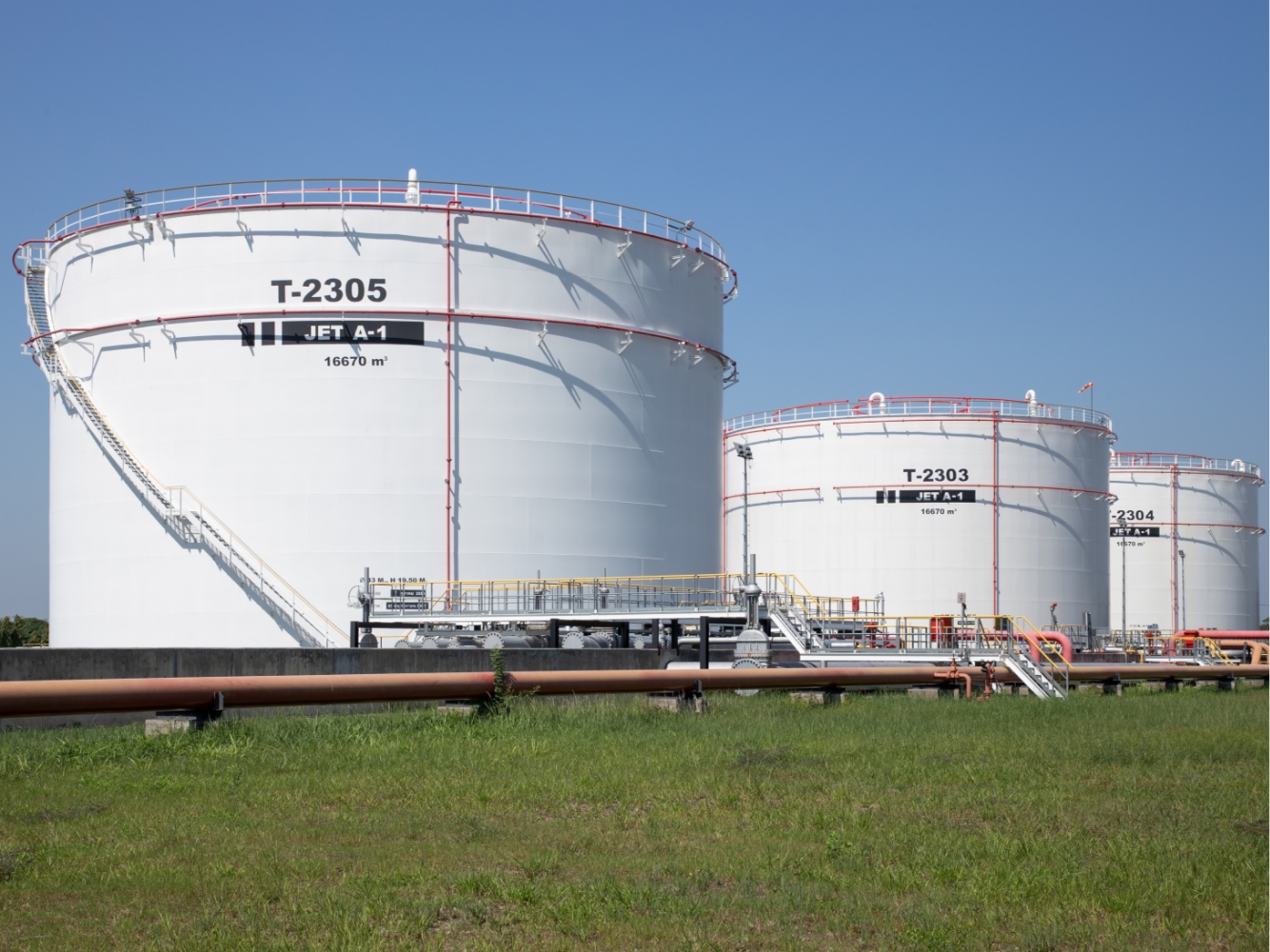
Additionally, the company is implementing a project to install an Internal Floating Roof (IFR) for the 15,000-cubic-meter aviation fuel storage tank (T-2305), together with associated systems, at the Suvarnabhumi Fuel Storage Facility. This project aims to reduce and prevent fuel vapor emissions to the atmosphere by no less than 95% and is scheduled for completion within 2025. The company is also transitioning its into-plane refueling vehicles from internal combustion engines to electric vehicles, recognizing the critical role refueling trucks play in its service operations. Furthermore, BAFS supports the provision of Sustainable Aviation Fuel (SAF) certified under the ISCC-CORSIA standard within the scope of its Logistics Center.
Air Pollution Management
The company recognizes and places importance on caring for and controlling the quality of air released into the environment.
Targets are set and emissions are controlled to be within specified standard values.
Emission reduction targets and operating results for the year 2022-2025 Control emissions not to exceed 80 % of the control value
Results of the analysis of the amount of volatile organic compounds
| Volatile Organic Compounds (VOCs) | The control value (mg/l) |
Target (mg/l) |
Measurement results | Evalutaion (Pass/Did't Pass) |
|||
|---|---|---|---|---|---|---|---|
| 2525 | 2024 | 2023 | 2022 | ||||
| Volatile Organic Compounds (VOCs) | 17 | 14 | 0.146 mg/l | 0.007 mg/l | 0.070 mg/l | 0.189 mg/l | Pass |
Water pollution management
The company recognizes the importance of monitoring and controlling all water discharged from its operations. The discharged water includes rainwater and domestic wastewater from office facilities. The company conducts annual sampling and testing of effluent quality, and all measured parameters remain within the legal standards required by applicable regulations.
| Index | Unit | Suvarnabhumi Depot | Don Mueang Depot | Standard | ||
|---|---|---|---|---|---|---|
| Results 6 May 2025 | Results 12 May 2025 | Results 7 May 2025 | Results 11 May 2025 | |||
| pH | - | 6.7 | 7.5 | 6.7 | 7.9 | 5.5 - 9.0 |
| Biochemical Oxygen Demand | mg/l | 2.2 | <2.0 | 3.5 | <2.0 | 30 |
| Total Suspended Solids | mg/l | <5.0 | <5.0 | 7.7 | 6.4 | 40 |
| Total Dissolved Solids | mg/l | 384 | 328 | 240 | 267 | 1000 |
| Sulfide | mg/l | <0.4 | <0.4 | <0.4 | <0.4 | 1 |
| Total Kjeldahl Nitrogen | mg/l | 1.6 | 2.5 | 4.4 | 3.9 | 35 |
| Fat Oil and Grease | mg/l | 1.2 | <1.0 | 2.2 | <1.0 | 20 |
| Chemical Oxygen Demand | mg/l | <40 | <40 | <40 | <40 | |
| Total Phosphorus | mg/l | 0.26 | 0.09 | 0.42 | 0.09 | |
| Water destination | Khlong Nong Ngu Hao | Khlong Prem Prachakorn | ||||
มาตรฐานตามประกาศกระทรวงทรัพยากรธรรมชาติและสิ่งแวดล้อม พ.ศ.2567 เรื่อง กำหนดมาตรฐานควบคุมการระบาย น้ำทิ้งจากอาคารบางประเภทและบางขนาด