Climate Change Management


BAFS recognizes that climate change poses severe impacts on the environment and the quality of life in society, with its intensity expected to increase in the future. As a result, the global community has come together to address this issue under the Paris Agreement, established within the framework of the United Nations Framework Convention on Climate Change (UNFCCC). Thailand has also prioritized this as an urgent agenda, requiring all companies to take action in reducing greenhouse gas emissions to help limit global temperature not exceeding 1.5 to 2 degrees Celsius.
UN SDG 13: Climate Action
BAFS acknowledges the challenges posed by climate change and operates its business with a focus on minimizing climate impacts through the Net Zero Master Plan. Our company aims to achieve a 20% reduction in greenhouse gas emissions by 2030, in line with its medium-term goals, and to reach Net Zero by 2050
Climate Change Management
BAFS has established a clear climate change governance structure, including policies, targets, key performance indicators, as well as risks and opportunities. This framework comprehensively covers all levels, from the Board of Directors to operational levels, ensuring an effective path toward the Net Zero target.
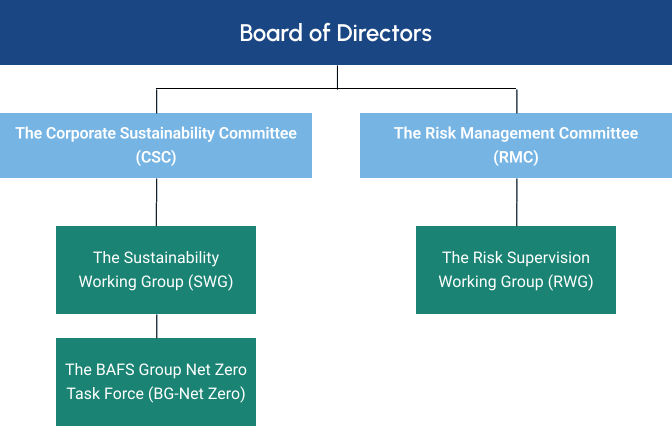

The Corporate Sustainability Committee (CSC), chaired by the Chairman of the Executive Board and representing the Board of Directors, plays a key role in establishing the group’s climate change policy framework. It is also responsible for monitoring the progress of the BG-Net Zero Task Force and the Sustainability Working Group (SWG) to ensure the company achieves its Net Zero target by 2050. The CSC reports quarterly on climate-related performance to the company’s Executive Board.

The Sustainability Working Group (SWG), chaired by a representative of the Board of Directors, is responsible for driving climate change initiatives, monitoring implementation progress, and overseeing greenhouse gas emission reduction efforts. The SWG reports quarterly to the Corporate Sustainability Committee (CSC).

The company has established the BG-Net Zero Task Force, chaired by the Director of Strategy and Sustainability, to drive efforts toward achieving net-zero greenhouse gas emissions. The task force has set carbon reduction targets and defined a base year to align with the business growth trajectory of the group. Additionally, a master plan for greenhouse gas reduction has been developed. The BG-Net Zero Task Force reports quarterly progress on its initiatives to the Sustainability Working Group (SWG).

The Risk Management Committee (RMC), RMC is essential in establishing risk management policies, overseeing BAFS Group’s overall risk management, and appointing the Risk Supervision Working Group to identify, assess, control, and monitor significant risks, including climate-related risks. These high-impact risks are classified as corporate risks and are directly supervised by the RMC. The audit Committee (AC) conducts quarterly reviews of the risks management system., and the Board of Directors receives quarterly risk management reports for acknowledgment.

The risk Supervision Working Group (RWG), RWG aligns BAFS Group’s risk management with the COSO ERM Framework, addressing ESG and climate risks. Quarterly reports to the RMC ensure transparency and support sustainable development
Road to Net Zero Emissions
20%
Reduce Scope 1, 2, and 3 Greenhouse Gas Emissions by 2030 (Short-term target)
60%
Reduce Scope 1, 2, and 3 Greenhouse Gas Emissions by 2040 (Mid-term target)
Net Zero
Achieve Net Zero Emissions by 2050 (Long-term target)
BAFS GROUP will continue to deliver sustainable value by reducing our emissions according to the global temperature of 1.5 Degree Celsius and announcing the Net Zero target within 2050 through our “ZERO” Strategy
Zero Emission

Energy Transition

Response to nature and low Carbon Society

Opportunity for green portfolio


Organizational Greenhouse Gas Inventory
Our company prepares a greenhouse gas (GHG) emissions inventory following the calculation guidelines of the IPCC and TGO, with verification by the third party. This inventory covers Scope 1, Scope 2, and Scope 3 emissions. Additionally, the company annually obtains certifications for Carbon Footprint Organization (CFO), Carbon Neutrality, and the Net Zero Pathway from TGO to enhance sustainability and work towards the Net Zero target. The details of GHG emissions for each scope are as follows:
Scope 1
Direct emissions
- Mobile combustion (Diesel and Gasoline)
- Stationary Combustion (Diesel ang LPG)
- Fugitive emissions (CO2 fire extinguisher)
- Wastewater treatment (CH4)
- Refrigerant (R-32, R-134a and R-410a)
- SF6
Scope 2
Indirect emissions
- Electricity
Scope 3
Other indirect emissions
- Purchased goods and services
- Stationary Combustion (Diesel and LPG)
- Fugitive emissions (CO2 fire extinguisher)
- Electricity (Fuel- and energy related activities)
- Upstream transportation and distribution (paper and water)
- Waste (General and hazardous waste)
- Business travel (Internal bus and air travel)
- Employee commuting
Greenhouse Gas Management (Scope 1, 2, and 3)
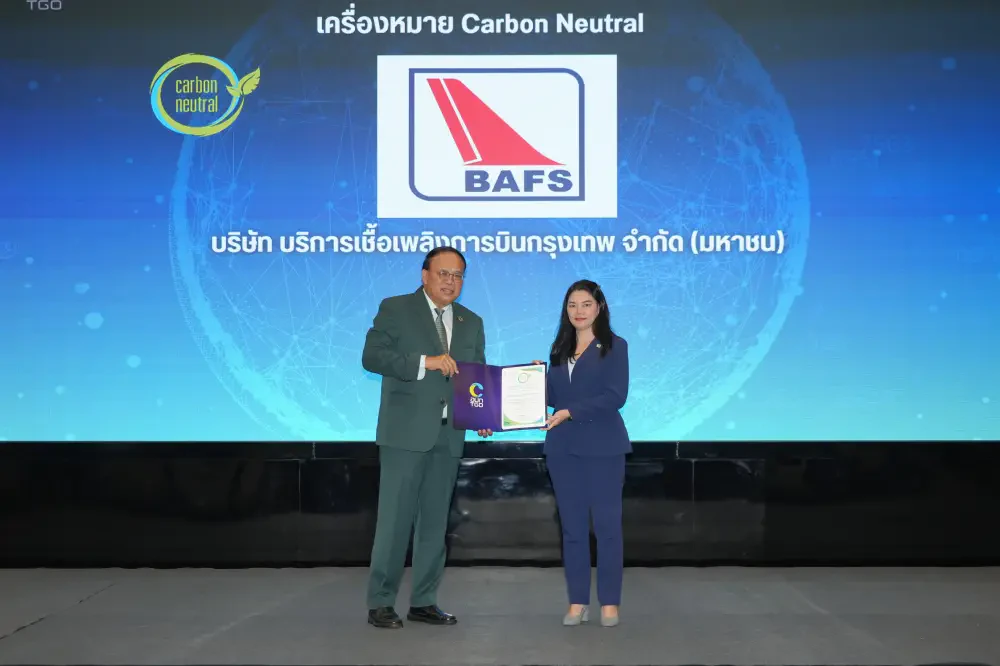
BAFS conducts an annual greenhouse gas emissions assessment to achieve Carbon Neutrality and reach Net Zero emissions by 2050. The company implements a Carbon Footprint for Organization (CFO) accounting system, covering Scope 1, 2, and 3 across all operational sites. This data is externally verified to ensure accuracy and transparency. Additionally, BAFS offsets its total greenhouse gas emissions through carbon credits from emission reduction projects, successfully achieving the status of a Carbon Neutral Company.
The amount of GHG emissions is
6,326 tCO2e
in 2023
6,777 tCO2e
in 2024
6,499 tCO2e
in 2025
Scope 1 : Direct emissions



Scope 2 : Indirect emissions



Scope 3 : Other indirect emissions



Carbon Intensity
GHG emissions per volume of aviation fuel service (tCO2e/M.liter)
The company's greenhouse gas emissions performance in the current year compared to the base year
In 2025, the company has implemented a quarterly monitoring and analysis process for greenhouse gas (GHG) emissions from its operations, comparing the results with the 2024 base year. This ongoing assessment enables the company to track emission trends and enhance the effectiveness of measures to reduce GHG emissions in alignment with current circumstances. Additionally, the data collected serves as a foundation for developing the company’s sustainability strategies and supporting concrete actions to minimize environmental impacts. It also strengthens transparency in reporting to stakeholders, reflecting the company’s commitment to achieving long-term GHG emission reduction goals.
The amount of GHG emissions in 2024 (base year) is
6,777 tCO2e
The amount of GHG emissions of 2025 is
6,499 tCO2e
decreased by 4.10%


Scope 1
Scope 2
Scope 3
International Carbon Reporting
BAFS participates in climate change disclosures in accordance with international standards, including the Climate Disclosure Project (CDP) and the Task Force on Climate-related Financial Disclosures (TCFD). Both initiatives aim to assess the impacts, risks, and opportunities associated with climate change on business operations in the short, medium, and long term, covering the entire value chain. Additionally, these disclosures serve as a demonstration of best practices in climate-related financial reporting.
To effectively manage climate change issues, the company has integrated carbon reduction targets into its operations by implementing a performance-based incentive program. This program aligns employee and executive compensation at all levels with the organization’s carbon reduction goals, reinforcing the company’s commitment to sustainability.
Company's 2024 Standard Performance Results and Indicators
In 2024, BAFS was rated at the "C" level (Awareness Level) by the Climate Disclosure Project (CDP), reflecting the company's commitment to environmental transparency. This rating indicates that BAFS has disclosed key climate-related information and recognizes the impact of environmental risks and opportunities on its business. The ranking serves as a critical foundation for driving progress in climate-related actions and disclosures in the future.
In addressing climate change issues, the company has established a special compensation scheme based on carbon reduction outcomes aligned with the organization's targets. This applies to employees and executives at all levels, integrating greenhouse gas reduction objectives into operations and effectively driving the organization's sustainability.
BAFS was rated at the "C" level (Awareness Level) by the Climate Disclosure Project (CDP)


Climate Change Strategy Operations
To achieve the Net Zero greenhouse gas (GHG) emissions target, BAFS continuously implements various initiatives, focusing on energy efficiency, the use of renewable energy, and the adoption of environmentally friendly technologies. The following projects are part of these efforts: